SeaBioComp
Development of low-impact biocomposites for the marine environment.

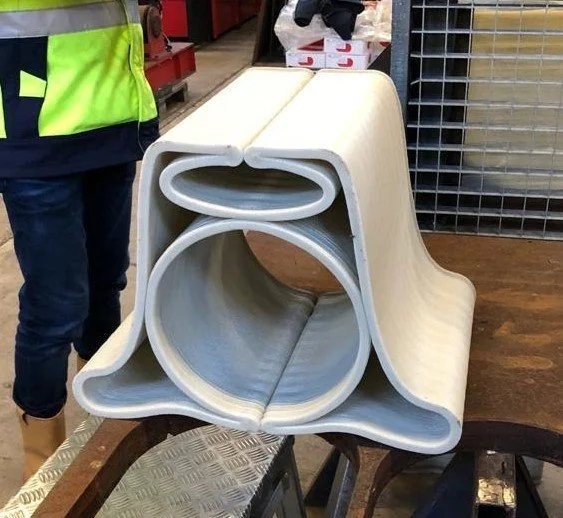
In 2021, SeaBioComp produced its first 3D-printed biopolymer profile for marine protection applications.
This first “product concept”, a maritime protection profile, was printed using an FDM printer by Poly Products (a Dutch company specialising in composite engineering and manufacturing and a partner in the SeaBioComp project), in collaboration with De Klerk Waterbouw (a company specialising in the installation of products for the marine environment and an associated partner of the project). The SeaBioComp project funded Poly Products’ research into the adaptations required to enable the 3D printer to process biopolymers. Research and testing on temperature control, natural fibre selection and corrosion of extruder components were all examined in depth.
De Klerk Waterbouw sought to study the design and production of a vertical biocomposite protection profile for vessel berthing and guidance, as an alternative to the tropical hardwoods and synthetic plastics traditionally used.
The results of material testing carried out by the University of Portsmouth and mechanical testing performed by De Klerk Waterbouw are very promising: further optimisation of designs, materials and production processes could lead to future large-scale manufacturing.
“The proposed biocomposite materials, together with the analytical protocols developed to ensure long-term durability and ecotoxicity performance, are expected to drive a shift in mindset across the entire value chain, demonstrating that bio-based composites represent a realistic alternative to petroleum-based products.”
-
To develop and deliver demonstrators using innovative bio-based composite materials with the following characteristics:
Application-specific durability, ranging from 2 to more than 20 years, for a demonstrator operating in a marine environment, as assessed using newly developed analytical methods;
Mechanical properties at least equivalent to those of conventional petroleum-derived composites;
Reduction in CO₂ emissions (30%) and reduced ecological impact of microplastics on the marine environment, as measured using recently developed analytical methods;
Demonstration of the recyclability of the materials used in the demonstrator.
These characteristics are expected to reduce the overall environmental impact by 50% compared to conventional petroleum-based products across the entire value chain, from production to end-of-life management.
-
SeaBioComp brings together 11 partners from the 2 Seas region, covering the coastal areas of the southern North Sea and the English Channel, including four EU Member States: England, France, the Netherlands and Belgium.
The project partners include research institutions, academic research groups, SMEs and cluster organisations.
To ensure the success of the project, expertise in a wide range of fields—such as polymer and textile formulation (Centexbel, CETI), composite manufacturing (Armines, University of Plymouth and Polyproducts BV), and environmental impact and durability assessments in marine environments (University of Portsmouth, VLIZ and Ifremer)—has been combined within the SeaBioComp partnership.
http://www.seabiocomp.eu/partners/
-
Visit the website: http://www.seabiocomp.eu/