PHOTONITEX
The PHOTONITEX project develops new types of smart textiles aimed at improving individual thermal and moisture comfort.
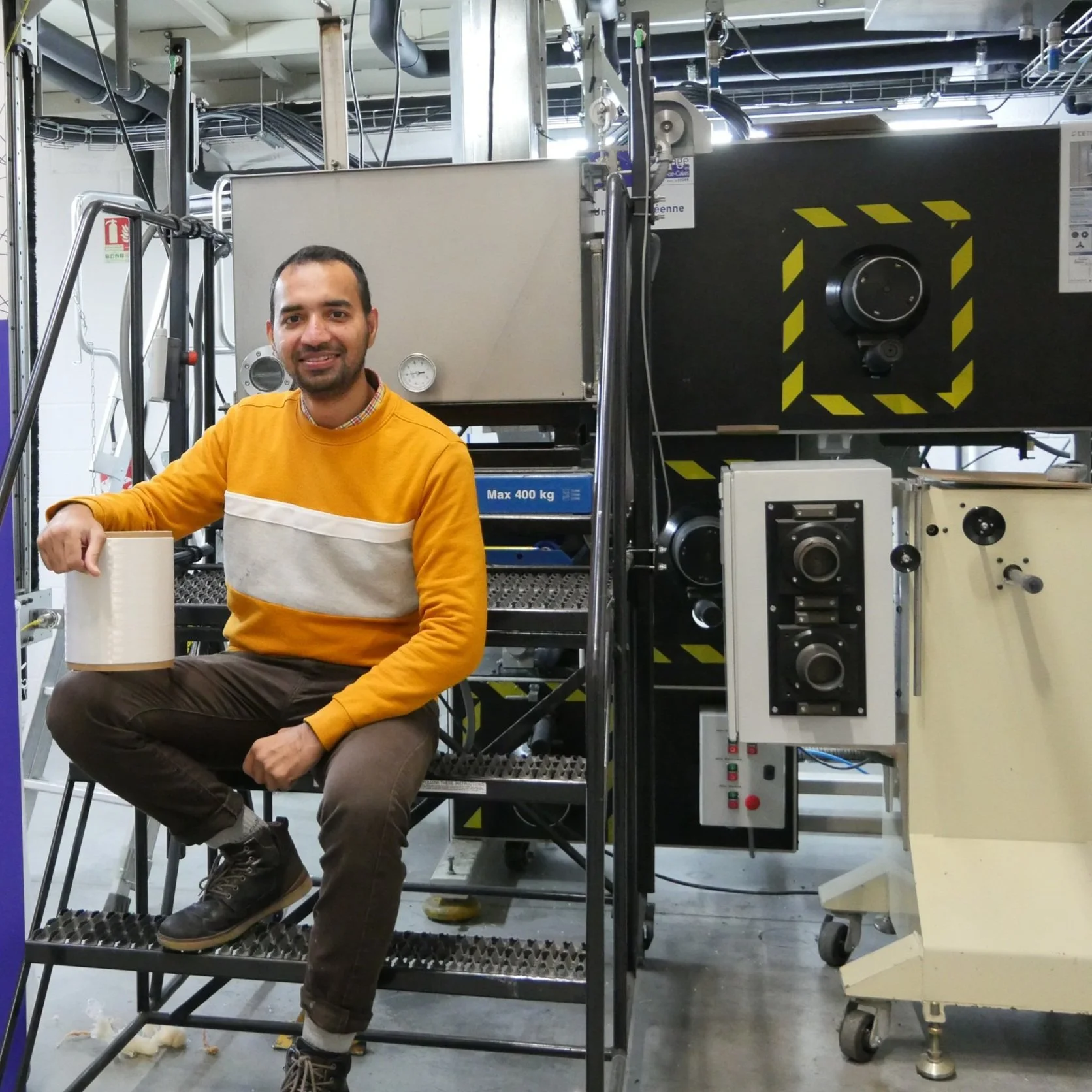
On 16 September at the GFC Dornbirn exhibition, Haleem Hafiz, PhD, shared the latest results and achievements of the PHOTONITEX project.
PHOTONITEX seeks to develop a new generation of smart textiles capable of enhancing thermal comfort through the dynamic regulation of the air gap between the skin and the textile. These innovative garments will be able to reflect infrared radiation back towards the body depending on usage conditions, namely temperature (body or ambient) and humidity (perspiration).
This functionality is not limited to sports applications. It is also intended for personal protective equipment, thermal insulation, defence engineering, as well as interior textiles.
To achieve this objective, PHOTONITEX draws inspiration from photonic structures—nanostructures that interact with light as a function of wavelength (i.e. colour). Such structures are responsible, for example, for the iridescent colours observed in certain butterfly species. While their fabrication typically relies on nanotechnologies, PHOTONITEX has developed analogous structures tailored to infrared “light”, using processing methods compatible with textile manufacturing at industrial scale
“The human body exchanges heat with the environment through various mechanisms, such as radiation, evaporation, conduction and convection. Thermo-physiological comfort is associated with efficient heat transfer between the body and the atmosphere, maintaining body temperature within a tolerable thermal range (36.5–37.5 °C).
To ensure comfort, body heat must be either retained or dissipated, depending on external conditions.
If body heat is not properly managed, it may lead to hyperthermia, heat stress and thermal discomfort.”
-
Increase the TRL of stimuli-responsive smart textiles
Develop and validate textiles capable of dynamically regulating thermo-physiological comfort through infrared radiation management, progressing from lab concepts to industrially compatible demonstrators.Enable scalable textile manufacturing of photonic-inspired structures
Translate photonic principles to infrared-responsive microstructures using processes compatible with industrial textile production.Provide passive, low-energy thermal regulation solutions
Demonstrate energy-free textile alternatives to battery-powered thermal regulation systems, reducing energy demand and improving user autonomy.Demonstrate cross-sectoral application and impact
Validate performance and relevance across key sectors including PPE, sportswear, defence, insulation and interior textiles.
-
PHOTONITEX relies on a cross-border consortium capable of addressing these requirements:
Materia Nova (project leader)
Centre Européen des Textiles Innovants (CETI) / EuraMaterials
ENSAIT
CNRS
HEI
University of Mons
University of Lille
Ghent University
-